Inside the edge-to-cloud AI strategy of the world’s largest chipset designer: doubling its AI ASIC revenue target to $2 billion, co-developing AI PC silicon with NVIDIA, named a launch partner for Google’s new Googlebook, and quietly building world-class advanced packaging and interconnect capabilities across the latest process nodes.
Last week, I flew into Taipei for COMPUTEX. The kind of week where you walk fifteen miles a day, drink your weight in oolong, and shake more hands than you have any reason to remember, plus a few you will. On the flight over from SFO, the setup was familiar. Sony XM6 headphones on, the seatback running 4K I had no intention of watching, my Kindle on the tray table holding the book Anjali made me promise to finish before she leaves for NYU.
Three of the four devices in that little setup ran on MediaTek silicon.
Then I landed. The first evening, I stepped out for a quick dinner at a Chick-fil-A near my hotel. The point-of-sale terminal was brand new. I noticed it before I noticed the menu. Then I noticed the kitchen display, the printer in the back. Same story: Powered by MediaTek.
Most people who own those devices would tell you MediaTek is a mobile chipmaker. They would not be wrong. They would also be missing about three-quarters of what we actually do. (That gap between perception and reality is the most interesting marketing problem I’ve worked on in years. Now, I am on a mission to close it.)
 MediaTek: Unraveling the myth; Image created with Gen-AI
Mobile, the Foundation We Keep Building Higher On
Let me start with mobile, because mobile is not what you think.
We are the world’s largest mobile chipset provider. In Q3 2025, we accounted for roughly 34% of global smartphone SoC shipments, ahead of all competitors. Our flagship business is on fire. The Dimensity 9500 launched on September 22, 2025, and flagship smartphone revenue is on track to exceed $3 billion for the year, growing more than 40% year over year. We have not relinquished the global mobile shipments lead to our nearest competitor in a single quarter this decade. Not one.
What’s coming next is bigger. We taped out our first flagship SoC on TSMC’s 2nm N2P process in September 2025, with mass production targeted for late 2026. We are one of the earliest movers on a node that Apple, AMD, and NVIDIA are all lining up for. Being early to advanced nodes is not a press-release game. It is a structural advantage that compounds across every product line we ship.
And that mobile foundation is extending up into compute. In May, Google unveiled its new Googlebook category, a premium, AI-first laptop platform launching this fall, with more details surfacing at Google I/O. MediaTek was named one of the early silicon launch partners for Googlebooks. Our Kompanio Ultra 910 already powers the Lenovo Chromebook Plus 14 with up to 50 TOPS of on-device AI compute. That is a real device on the market today, running Gemini features locally without a round trip. The Googlebook win takes that same foundation directly into Google’s premium tier.
On June 1, NVIDIA unveiled its AI PC processor, RTX Spark, at Computex, co-developed with MediaTek. This will power flagship Windows AI PC platforms launching across Dell, Lenovo, and other OEMs. That collaboration follows the same partnership pattern that produced the GB10 Grace Blackwell Superchip powering NVIDIA’s DGX Spark.
Mobile is the muscle. Compute is the natural extension. Mobile is not the past we are growing beyond. It is the foundation we are building higher on.
The Silicon Already In Your Hands
Now take a walk through my house in Eagle, Idaho. The Peloton in my home gym (the one that has taken more abuse this year than my fitness tracker is willing to admit) runs on MediaTek silicon. The Alexa devices Mita has tolerated me installing in every corner of our house; the count is now somewhere north of ten, and I have stopped admitting the actual number out loud, run on MediaTek silicon. The Sony smart TVs in three rooms, the Wi-Fi 7 mesh router tying the whole thing together. MediaTek silicon.
This is not a hidden footprint. This is the floor of the modern device economy.
The numbers underneath the floor are bigger than most people realize. We power more than two billion connected devices a year. Kindle e-readers. Smart speakers from every major brand you have heard of. Fitness equipment. Home security cameras. Quick-service restaurant systems across Asia. Wi-Fi 7 silicon at scale. Agentic AI systems for drones. High-speed internet powered by Satellites. Bluetooth audio across the premium headphone category. Our silicon is doing the unglamorous work of holding the whole thing together.
When AI starts running on the device as it does in the cloud, and it will, faster than most people realize, every one of those two billion devices becomes a potential Agentic AI surface. That is not an aspiration. That is an installed base.
Automotive: The Long Game That’s Paying Off
Cars are now computing platforms with wheels. (My kids find this less revolutionary than I do. I find this concerning.)
We have been investing in automotive for years, long before the software-defined vehicle became a catchphrase for every keynote speaker. Our partnership with NVIDIA now goes well beyond marketing. The flagship Dimensity Auto Cockpit Platform C-X1 integrates directly with NVIDIA’s DRIVE AGX, sharing resources via DriveOS to provide automakers with a unified cabin and driver compute platform.
The automotive collaboration is one thread of a deepening relationship. The same engineering muscles that produced GB10, that show up in cockpit silicon, and that we now bring to AI PCs all come from the same playbook: pair our leading-edge SoC capability with NVIDIA’s GPU and software, and ship at scale.
In October 2025, we signed a joint development agreement with DENSO to co-design custom automotive SoCs for advanced driver-assistance and cockpit systems, targeting ISO 26262 compliance at ASIL-B and ASIL-D safety levels. That is a serious commitment between two companies, not a press release. Auto revenue more than doubled year over year in Q4 2025, with the trend extending into 2026.
I have been driving software-defined cars for over a decade now. The first ones felt like science experiments with leather seats. The ones I drive today feel like AI data centers on wheels. The companies winning in automotive are not the ones with the loudest CES demos. They are the ones who locked in the design wins five years before anyone outside the industry was paying attention.
 MediaTek Automotive Solutions; Image created with Generative-AI
Data Center: The Quiet Build That Just Got Loud
Here is the headline that most of the market is still digesting. On our Q1 2026 earnings call at the end of April, we doubled our AI ASIC revenue target. We now expect approximately $2 billion in AI ASIC revenue from our first U.S. hyperscale customer project in Q4 2026 alone, up from a $1 billion target only one quarter earlier. The program scales to multiple billions of dollars in 2027. Our 2027 TAM estimate rose to $70-$80 billion. We are targeting 10 to 15% market share, which puts our 2027 ASIC revenue trajectory in the $7 to $12 billion range.
The market noticed. Taiwan’s stock exchange placed our trading under restrictions in early May after our market cap pushed past $165 billion. (For a company, most people still file under ‘mobile chips,’ that is, a lot of zeros.)
Here is the part that earns those numbers. We have been designing enterprise networking and data center silicon since 2014. In 2018, we shipped a 91-square-millimeter data center package, among the largest of its kind at the time. That was not a tech demo. It was an advanced packaging muscle being built for a moment that had not yet arrived.
That moment is now.
We are one of the earliest adopters of TSMC’s 2nm N2P process for both mobile and data center silicon. Our decades-long strategic partnership with TSMC runs deep, with both companies connected with a similar DNA. We also work with Intel Foundry Services when our partners need us to on smart-edge silicon, a partnership that gives us a balanced, resilient supply chain with significant capacity across the United States and Europe. Advanced process technology, high-speed interconnects, and advanced packaging are no longer optional in AI infrastructure. They are the constraints. Having spent a decade building those capabilities across geographies is the kind of head start you cannot manufacture on demand.
The Fabric of AI
Here is where the strategy clicks together.
We are not a traditional chip company in any sense. We are One MediaTek, weaving the fabric that AI runs on. The fabric is made of many threads: custom AI ASICs for hyperscalers, mobile SoCs that bring generative AI on-device, IoT and edge silicon across more than two billion connected devices a year, automotive platforms turning cars into computing nodes, connectivity silicon (Wi-Fi 7, 5G-Advanced, Bluetooth) tying the layers together, advanced process and packaging across the world’s leading foundries, and developer SDKs that make all of it accessible.
Two threads matter more than most people realize. The first is co-design at the highest level of the AI stack. The GB10 Grace Blackwell Superchip in DGX Spark and the NVIDIA RTX Spark announced in June are products of the same playbook: MediaTek’s SoC expertise paired with NVIDIA’s GPU and software, built for systems that actually ship to customers. The second is developer access.
At COMPUTEX 2024 we integrated NVIDIA’s TAO Toolkit with our NeuroPilot SDK. Developers can now take more than 100 pretrained Vision AI models, fine-tune them with NVIDIA tools, and deploy them across our entire edge silicon portfolio with one workflow. That is the unglamorous, foundational work that decides whether AI actually reaches the two billion devices we ship every year, or stays locked inside a few hundred data centers.
Most companies in our space pick a layer and own it. We are operating across all of them, on purpose. AI is not going to be defined by a single chip or a single cloud. It will be defined by how the layers work together and by who has the threads to weave them. We do.
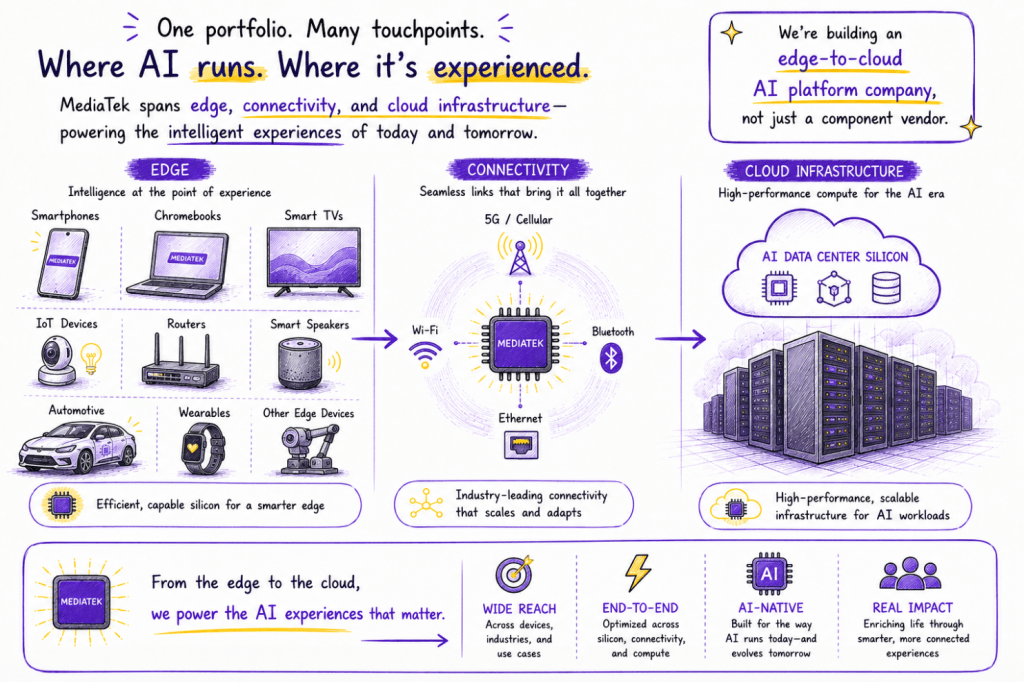 One MediaTek: From Edge to Cloud; Image created with Generative-AI
The Brand Is Catching Up to the Business
A few months ago, Interbrand released its 2025 Best Taiwan Global Brands ranking. We held the number three spot for the third year running, with a brand value of $2.04 billion. The growth rate was 45% year over year. The fastest in the entire ranking. We also entered Brand Finance’s Top 10 most valuable semiconductor brands this year with a $5.7B brand value and their Top 4 strongest brands with an AA+ rating (again beating out our nearest competitor).
Brand growth like that is not the output of a marketing campaign. It is the lagging indicator of a business that has been compounding quietly for years. We do not need to get louder. The work is loud enough on its own. What we owe the world is clarity, not volume. Tell the truth about what we do, in plain terms, and trust that the people paying attention will figure it out.
(The people paying attention, it turns out, include the entire global semiconductor analyst community. Welcome to the conversation.)
Why I’m Here
I spent six years at Micron working on memory and storage. Memory is the substrate AI runs on. Every model, every inference, every training lives in DRAM, NAND, or HBM. I loved the work, and I still root for them on every earnings call. I also attended their partner event this week as a customer and it felt like a homecoming!
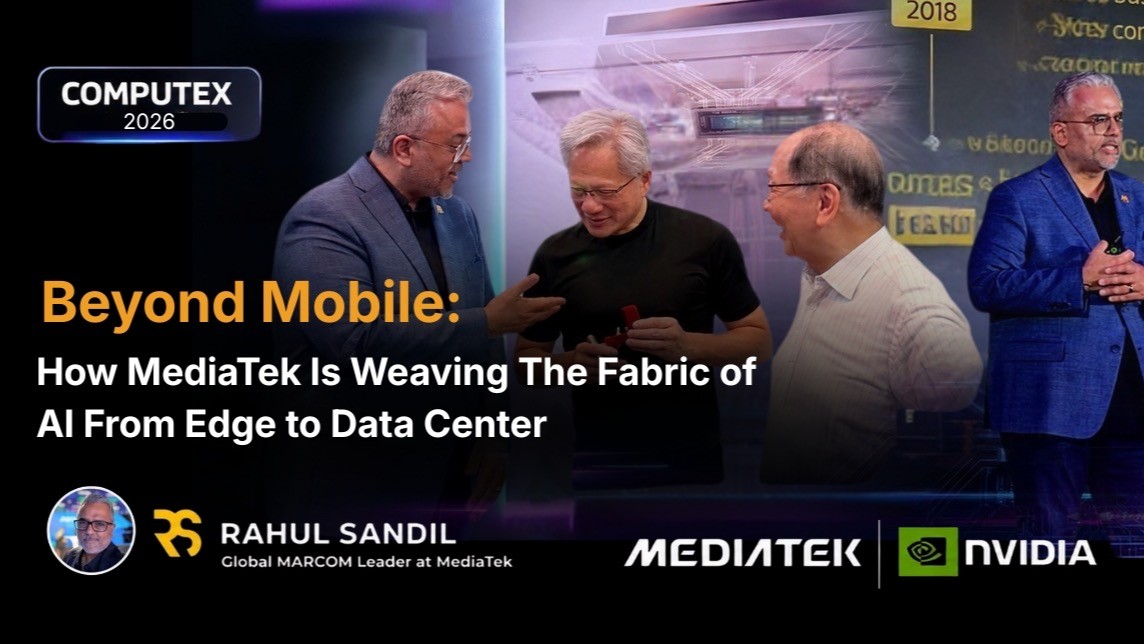
I came to MediaTek because the next layer of the stack was being built in Hsinchu and beyond, and I wanted to help build it. Chips, racks, interconnects, system-level design, advanced packaging, developer SDKs. AI is going to be the defining technology of the next few decades and beyond, and somebody has to weave the fabric that covers everything. I wanted to be one of the people doing the weaving and talking about it. Watching Jensen unveil NVIDIA’s RTX Spark, co-developed with MediaTek, I had one of those rare moments where the bet I made eighteen months ago lined up exactly with what I thought it would accomplish.
I think about this most when I think about my family. Arjun is at Georgetown, figuring out what kind of lawyer he wants to be in a world where AI could rewrite half the content used in the legal profession. Anjali starts at NYU this fall, studying in a city being rebuilt in real time by AI, from search to retail to subway to street. Mita teaches yoga at senior centers across Boise. Her students walk into class from a world that is quietly being reorganized by AI. The centers use AI to plan their meals, manage their prescription refills, and coordinate their rides to medical appointments.
That is the world we are weaving. A world where everyone’s lives will be enriched through the democratization of intelligence. From chips to racks. From mobile to compute to automotive to data center. From the edge in your pocket to the cloud across the world. We are not catching up. We have been here. The story is just getting easier to tell.
 One MediaTek: Global Impact; Image created with Generative-AI
Frequently Asked Questions
MediaTek is the world’s largest mobile chipset provider, but the company also designs silicon for compute (Chromebooks and Google’s new Googlebook category), smart TVs, IoT and edge devices, automotive platforms, connectivity (Wi-Fi 7, 5G-Advanced, Bluetooth), and AI data center accelerators. MediaTek powers more than two billion connected devices a year.
On its Q1 2026 earnings call in April, MediaTek doubled its target. The company now expects approximately $2 billion in AI ASIC revenue from its first U.S. hyperscale customer project in Q4 2026 alone, up from a previous $1 billion target. The program scales to multiple billions of dollars in 2027, with the 2027 cloud ASIC TAM estimated at $70 to $80 billion and MediaTek targeting a 10 to 15% share.
Yes. Google named MediaTek as one of the early silicon launch partners for its new Googlebook category. Googlebook is a premium, AI-first laptop platform launching in fall 2026. MediaTek’s Kompanio Ultra 910 already powers the Lenovo Chromebook Plus 14 with up to 50 TOPS of on-device AI compute, running Gemini features locally without a cloud round trip.
MediaTek and NVIDIA are co-developing silicon across the AI stack. The partnership has already produced the GB10 Grace Blackwell Superchip powering NVIDIA’s DGX Spark, and on June 1, 2026, NVIDIA unveiled its AI PC processor, RTX Spark, launching with Dell, Lenovo, and other OEMs. Beyond silicon, MediaTek’s Dimensity Auto Cockpit Platform C-X1 integrates with NVIDIA’s DRIVE AGX in automotive, and NVIDIA’s TAO Toolkit is integrated with MediaTek’s NeuroPilot SDK for IoT and edge AI development, giving developers more than 100 pretrained Vision AI models for deployment across MediaTek edge silicon.
MediaTek is one of the earliest adopters of TSMC’s 2nm N2P process for both mobile and data center silicon, with the first 2nm flagship SoC tape-out completed in September 2025 and mass production targeted for late 2026. TSMC and MediaTek share a decades-long special and deep relationship. MediaTek also works with Intel Foundry Services as per our customers’ needs on smart edge silicon, building a more diversified and resilient supply chain with significant manufacturing capacity across the United States and Europe.
According to Interbrand’s Best Taiwan Global Brands 2025 ranking, MediaTek is the third-largest brand in Taiwan, with a brand value of $2.04 billion. MediaTek’s 45% year-over-year brand value growth was the fastest in the entire ranking. MediaTek also entered Brand Finance’s Top 10 most valuable semiconductor brands with a $5.7B brand value this year and their Top 4 strongest brands with an AA+ rating
About the Author
With over three decades of experience in marketing, communications, and business development, Rahul Sandil is a global marketing leader passionate about building brands, empowering teams, and delivering impactful results across industries. As Vice President and General Manager of Global Marketing and Communications at MediaTek, he serves as the company’s chief marketing and communications executive, overseeing global brand strategy, marketing innovation, strategic partnerships, and corporate communications that connect leading-edge technology with audiences worldwide.
Previously, Rahul held leadership roles at Micron Technology, where he was responsible for corporate marketing, as well as at other global organizations in the technology, digital media, and entertainment sectors, including Microsoft, Amazon, HTC, and others. As a board advisor, mentor, and consultant, he has leveraged his expertise in AI, emerging technologies, and advanced digital marketing to help companies achieve sustainable growth.
Rahul is passionate about creating customer-centric experiences that connect communities with technology. He believes in the power of storytelling, creativity, and data to drive business outcomes and social impact. He is also an avid geek and usually the first to adopt new consumer tech products. To read more about Rahul’s thoughts on AI, Marketing, and Leadership, check out his blog, connect with him on LinkedIn, subscribe to his Substack newsletter, or follow him on Medium.
Disclosure: The author leverages Generative AI platforms to support content research, copywriting, and editing for his blogs. All ideation, outlines, and strategic insights are the author’s own.
Related
