 DeepSeek Logo: Image courtesy of deepseek.com
As someone who’s spent years geeking out over the latest tech and innovations, I’ve seen AI go from clunky rule-based systems to mind-blowing, borderline sci-fi advancements. But what excites me isn’t just what AI can do—it’s how it does it. Enter DeepSeek AI: the chat agent quietly redefining how we think about generative AI. Spoiler alert—it’s not just another large language model vying for your attention. This thing has some serious game and is not afraid to play differently.
DeepSeek isn’t just showing up to the AI party; it’s rewriting the playlist, wearing sunglasses indoors, and making everyone rethink their dance moves. It’s not about being bigger, faster, or louder—it’s about being smarter. And clearly, people are catching on—at the time of writing, DeepSeek AI wasn’t just trending; it was the most downloaded app on iOS. So grab your popcorn (or your favorite edge-computing-enabled device), and let’s dig into what makes DeepSeek so exciting, why it could be a game-changer, and how it might just outsmart its competitors while using fewer resources.
1. What is DeepSeek AI?
At its core, DeepSeek AI is an inference-optimized AI architecture designed to deliver high-performance generative AI tasks with remarkable efficiency. Unlike traditional models like GPT-4, which rely heavily on massive data centers and thousands of GPUs, DeepSeek takes a different approach. DeepSeek offloads much of the computational heavy lifting to the edge—which means devices like smartphones, IoT gadgets, and even cars can handle complex AI tasks without constantly relying on the cloud.
Think of it this way: if traditional AI models are like power-hungry supercomputers, DeepSeek AI is more like a distributed network of smart, energy-efficient devices working together. It’s not just about doing more with less; it’s about doing it more intelligently.
2. Turning Constraints into Catalysts: DeepSeek’s Playbook for Innovation
DeepSeek’s journey becomes even more intriguing when framed against the backdrop of global challenges that many organizations face today. Geopolitical tensions, such as US sanctions limiting access to advanced chipsets like NVIDIA’s A100 and H100 GPUs, present significant obstacles for businesses reliant on high-performance computing. Yet these hurdles are not unique to geopolitics; organizations across industries often encounter constraints—limited capital, scarce resources, or energy inefficiencies.
If its claims hold, DeepSeek AI’s approach offers a potential blueprint for thriving under such conditions. By focusing on innovation designed to maximize efficiency and reduce reliance on traditionally essential resources, the company demonstrates how adversity can act as a catalyst for transformative change. For businesses navigating tight budgets, supply chain disruptions, or infrastructure limitations, this approach underscores the power of rethinking foundational strategies to turn limitations into opportunities.
While the long-term implications of DeepSeek’s strategy remain to be seen, it sets an intriguing precedent—highlighting that with the right mindset and a focus on ingenuity, even the most formidable constraints can inspire breakthrough solutions.
3. Why DeepSeek AI Stands Out
- Efficiency at Scale: DeepSeek’s architecture is seemingly optimized for low-latency, low-power inference. This means it could perform tasks like natural language processing, image generation, or real-time recommendations using 50% fewer GPUs in data centers than traditional models. How? Leveraging on-device memory, logic, and graphics to handle a significant portion of the workload. For example, instead of sending every query to a cloud server, your smartphone could process it locally, saving time and energy.
- Edge AI Revolution: One of DeepSeek’s most exciting aspects is its focus on edge computing. By pushing more AI processing to the edge, DeepSeek potentially reduces the need for massive data center infrastructure. This isn’t just a technical win; it’s a practical one. Imagine a world where your smart home devices, wearables, and car can run advanced AI models without lag or dependency on the cloud. That seems to be DeepSeek’s promise.
- Energy Efficiency: Let’s talk numbers. DeepSeek’s architecture claims to consume 40% less energy per task than traditional models. If true, this could be a game-changer in a world where sustainability is becoming a top priority. It’s not just about saving costs; it’s about reducing AI’s environmental footprint.
- Real-Time Performance: DeepSeek claims 60% faster response times for real-time tasks. Whether a voice assistant answers your question or a recommendation engine suggests your next favorite song, the speed, and responsiveness are unparalleled in my experience with the tool. This faster response time is where DeepSeek can genuinely shine, making AI feel seamless and intuitive.
4. What does DeepSeek’s Proliferation Mean for the AI Landscape?
The rise of DeepSeek isn’t just about a new AI model; it’s about redefining the rules of the game. Here’s how its proliferation could shape the future of AI:
- Democratization of AI: By reducing the reliance on massive data centers, DeepSeek makes advanced AI more accessible. Smaller companies and startups can now deploy sophisticated AI solutions without the need for enormous computational resources, leveling the playing field and fostering innovation.
- Edge Computing Takes Center Stage: DeepSeek’s focus on edge computing could accelerate the adoption of AI in areas where real-time processing is critical. Think healthcare (wearables that monitor your health in real-time), automotive (self-driving cars that make split-second decisions), and smart cities (traffic systems that adapt on the fly).
- Sustainability in AI: As generative AI becomes more pervasive, its environmental impact can’t be ignored. DeepSeek’s energy-efficient architecture can set a new standard for sustainable AI development. It’s a reminder that innovation and responsibility can go hand in hand.
- A Shift in Hardware Priorities: DeepSeek’s potential success could drive demand for custom AI accelerators and energy-efficient chips tailored for edge computing. This opens up exciting opportunities for hardware innovation, from specialized NPUs to next-gen SoCs.
5. What are the Risks and Challenges around Trust and Privacy?
While DeepSeek AI’s efficiency and edge-focused architecture are undeniably exciting, it’s essential to approach this innovation with a healthy dose of caution. Every technological leap comes with its own challenges, and DeepSeek is no exception.
One of the biggest concerns is user privacy. By shifting more AI processing to the edge, DeepSeek relies heavily on local devices to handle sensitive data. While this reduces dependency on cloud servers, it also raises questions about how securely this data is managed. If not implemented carefully, edge AI could become a new vector for privacy breaches, especially in devices with limited security measures.
Another challenge is trust. As AI becomes more pervasive, users must feel confident that these systems are reliable and unbiased. While efficient, DeepSeek’s specialized training data could inadvertently introduce biases if not rigorously audited. Ensuring fairness and transparency in its decision-making processes will be critical to maintaining user trust.
Finally, there’s the question of scalability. While DeepSeek AI excels in efficiency, deploying it across millions of devices with varying capabilities could lead to inconsistencies in performance. Balancing innovation with robustness will be key to its long-term success.
In short, DeepSeek AI’s potential could be immense, but so are its responsibilities. As we embrace this new era of AI, we must tread carefully, ensuring that efficiency never comes at the cost of privacy, trust, or fairness.
A Personal Reflection
As a marketer, I’m always excited by innovations that challenge the status quo. DeepSeek isn’t just another AI model; it’s a testament to the power of rethinking fundamentals. It reminds me of the early days of mobile computing when we shifted from bulky desktops to sleek, powerful smartphones. DeepSeek feels like a similar leap—a move toward AI that’s smarter, more efficient, accessible, and sustainable.
What excites me most about DeepSeek AI’s potential is its ability to empower people and businesses. Bringing AI closer to the edge puts the power of generative AI in the hands of users rather than confining it to the cloud. It’s a vision of AI that’s not just transformative but also deeply human-centric.
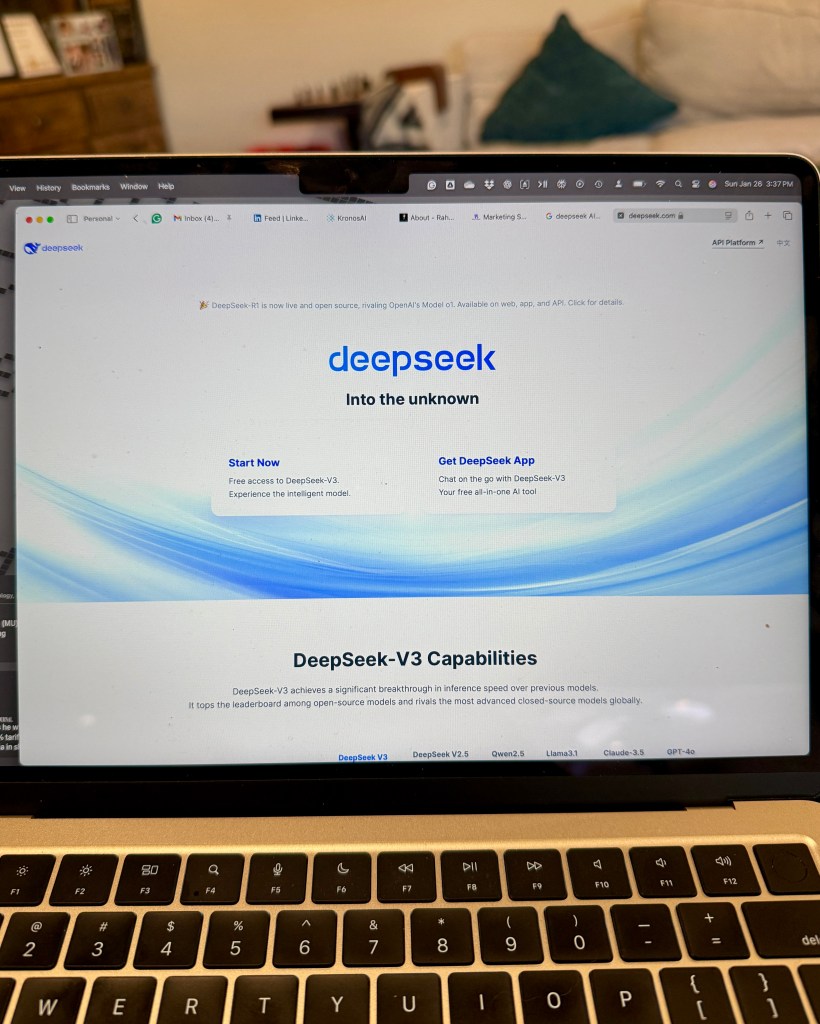 DeepSeek AI running on my MacBook Air
Final Thoughts
DeepSeek AI could be more than just a technical innovation; it may lead to a philosophical shift in how we approach AI. It challenges us to think beyond bigger models and more data centers and instead focus on efficiency, accessibility, and sustainability. As we move into an era where AI is woven into the fabric of our lives, architectures like DeepSeek will play a pivotal role in shaping that future.
So, whether you’re a tech enthusiast, a business leader, or just someone curious about the future of AI, DeepSeek is worth keeping an eye on. It may not just be changing the game—it may be rewriting the rules. Have you tried DeepSeek or other edge AI solutions? Share your thoughts—I’d love to hear how you see AI shaping the future.
 I asked DeepSeek to explain how it differs from Chat GPT-4 to an executive or a 10th grader! I think it did a good job and even made a table!
FAQs
- What makes DeepSeek AI different from other generative AI models like GPT-4?
DeepSeek AI focuses on efficiency and edge computing, distributing tasks to devices like smartphones and IoT gadgets instead of relying heavily on data centers. This approach reduces GPU usage, energy consumption, and dependence on cloud infrastructure.
- How does DeepSeek AI improve energy efficiency and reduce resource usage?
By leveraging on-device memory and processing, DeepSeek claims to consume 40% less energy per task and use 50% fewer GPUs. This localized approach minimizes strain on centralized systems and lowers environmental impact.
- What industries could benefit most from DeepSeek AI’s edge computing capabilities?
Industries like healthcare, automotive, and smart cities could benefit significantly from real-time AI processing. Applications include wearable health monitors, self-driving cars, and adaptive traffic systems.
- What challenges or risks are associated with DeepSeek AI’s approach?
Privacy risks arise as more sensitive data is processed on local devices, potentially lacking robust security. Additionally, scalability and trust issues, like biases in training data, could affect its broader adoption.
- How could DeepSeek AI impact the broader AI landscape?
DeepSeek’s innovations could democratize AI by reducing infrastructure costs and enabling smaller businesses to deploy advanced solutions. Its sustainability focus may also push the industry toward energy-efficient, decentralized AI models.
About the author
With over three decades of experience in marketing, communications, and business development, Rahul Sandil is a global marketing leader known for building brands, empowering teams, and delivering impactful results across industries. As Vice President and General Manager of Global Marketing and Communications at MediaTek, he serves as the company’s chief MARCOM executive. He drives global brand strategy, marketing innovation, strategic partnerships, and corporate communications that bridge leading-edge technology with audiences worldwide.
Previously, Rahul held leadership roles at Micron Technology, overseeing corporate marketing and at global organizations in technology, digital media, and entertainment, including Microsoft, Amazon, HTC, and more. As a board advisor, mentor, and consultant, he has applied his expertise in AI, emerging technologies, and advanced digital marketing to help companies achieve sustainable growth and drive innovation.
Rahul is passionate about creating customer-centric experiences that connect communities with technology. He believes in the power of storytelling, creativity, and data to drive business outcomes and social impact. He is also an avid geek and usually the first to adopt new consumer tech products. To read more about Rahul’s thoughts on AI, Marketing, and Leadership, check out his blog, connect with him on LinkedIn, subscribe to his newsletter, or follow him on Medium.
Rahul uses various Generative AI platforms to support research and the writing and editing of his blogs.
