Computex was one of those weeks that blur into a single, very long day, where somewhere around Wednesday you stop checking which hall you’re in and just follow the noise. This year a good share of that noise was about NVIDIA RTX Spark, a new superchip for Windows PCs built to run personal AI agents, and because MediaTek had collaborated with NVIDIA on its custom CPU design, the PC crowd was stopping at our booth to talk about something other than phones for once.
For a company and brand most people still file under Android chips, having our name attached to one of the launches everyone was talking about doesn’t happen every year. (For once nobody needed me to explain what MediaTek does, which left me with surprisingly little to say.)
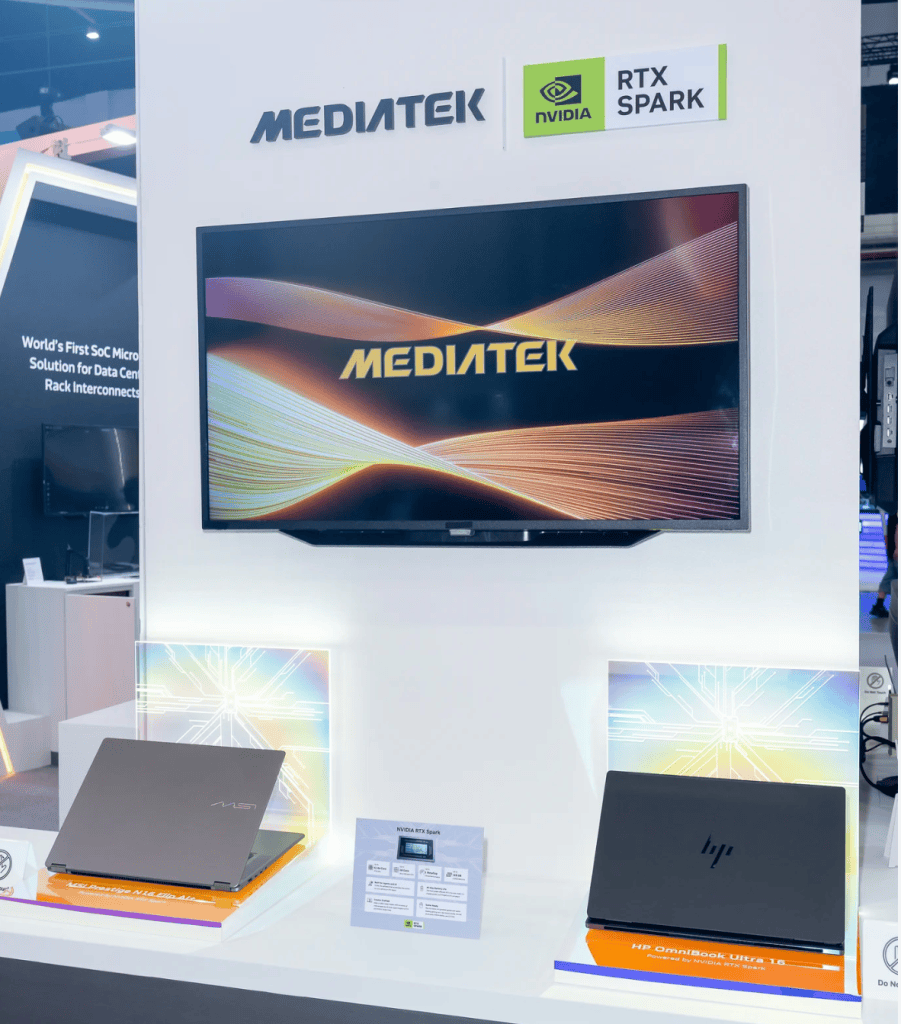 NVIDIA RTX Spark at the MediaTek booth, Computex 2026.
By the time I got back to my hotel that night, I was running on oolong and adrenaline and not much else, scrolling WhatsApp the way you do when your brain has quietly stopped accepting new meetings, when a message came in from an old business school friend in India. He’d been reading the coverage about a new generation of Windows PCs that run personal AI agents locally, powered by NVIDIA RTX Spark, and he wanted to say congratulations.
What he wrote next is what I’ve been chewing on ever since. He was a little surprised MediaTek was in flagship PCs at all, and that told me a lot, because he’s a geek like me and has owned both a vivo X200 and an OPPO Find X8, two flagships built on our Dimensity brand (good taste, I told him, twice). In his head, MediaTek was the company inside great Android phones, and the story ended there.
So I did what any marketer does at midnight with a captive audience and a phone keyboard. I reminded him that MediaTek is the number one chip supplier for non-x86 Chromebooks, so personal computing wasn’t exactly new territory for us, and then I kept going, because we’re also the number one chip supplier in smart TVs, a leader in connectivity (Wi-Fi and Bluetooth), and we’ve moved into the AI data center with custom AI ASICs. I could practically feel the disbelief coming through the typing bubbles.
He isn’t some stranger at a conference who’d never heard of us. He’s sharp, he reads the business press, he carries our flagship silicon in his pocket every day, and he still had a version of MediaTek in his head that was a few years out of date (if that’s true of him, I’d rather not think too hard about what’s true of everyone else).
Why does the label always show up late?
Brands have terrible reflexes, which is one of the stranger things I’ve learned in this job. Inside a company, the change feels obvious because you live it every day, in the products you ship and the rooms you suddenly get invited into, while outside, people are still describing you with whatever sentence they picked up the last time they paid attention (which, for most people, was a while ago).
It’s tempting to blame the market for that, and I suspect every marketer reading this has done it at least once, usually in a closed conference room. I certainly have. But the market is mostly doing what we trained it to do: if the only story people have heard from you is the old one, that’s the story they’ll keep repeating long after it stops being the whole truth.
So what actually closes the gap? I’ve had to answer that question at three very different companies, and each time I learned (usually the expensive way) that you can’t message your way out of it. People change their minds when you show them something, and if all you do is tell them, you end up with a beautiful brand campaign nobody remembers. The proof also has to be specific enough that someone can retell it at dinner without looking anything up, which turns out to be a much higher bar than most of us set.
Micron, 2022: Why memory matters?
I’d just been promoted to VP and Global Head of Marketing at Micron when the CHIPS Act conversation was heating up in Washington, and my team and I were building the narratives, brand campaigns and content to support the company’s efforts there. We had a problem that anyone who has ever marketed a component will recognize: memory was everywhere, and it was standardized by JEDEC down to the pin, so to a lot of analysts and policymakers it looked like a commodity, something you buy by the truckload and never think about the brand again.
Our job was to show them that memory sat at the heart of intelligence. It was in the phone in your pocket and in the advanced computers hospitals rely on to save lives, it was in the car in your driveway, and it was in the large data centers that were about to become the training grounds for an AI revolution most people hadn’t seen coming yet.
What finally made that story land for the brand was proof people could hold onto, starting with Micron’s plan to invest $40 billion in U.S. memory manufacturing, announced in August 2022 right as the CHIPS and Science Act passed, and backed by real examples of where memory was already doing the heavy lifting. (Try telling an AI training cluster that its memory is a commodity; it will answer you, very slowly.)
Two months later Micron announced plans to invest up to $100 billion over 20-plus years in a new memory megafab in Clay, New York, and we turned the same idea into a wall you could physically walk along. We called it “Memory is Everywhere,” and it ran from home and health care through virtual reality, security, AI, mobile, gaming and computing, with a real device sitting on each pedestal so nobody had to take our word for any of it.
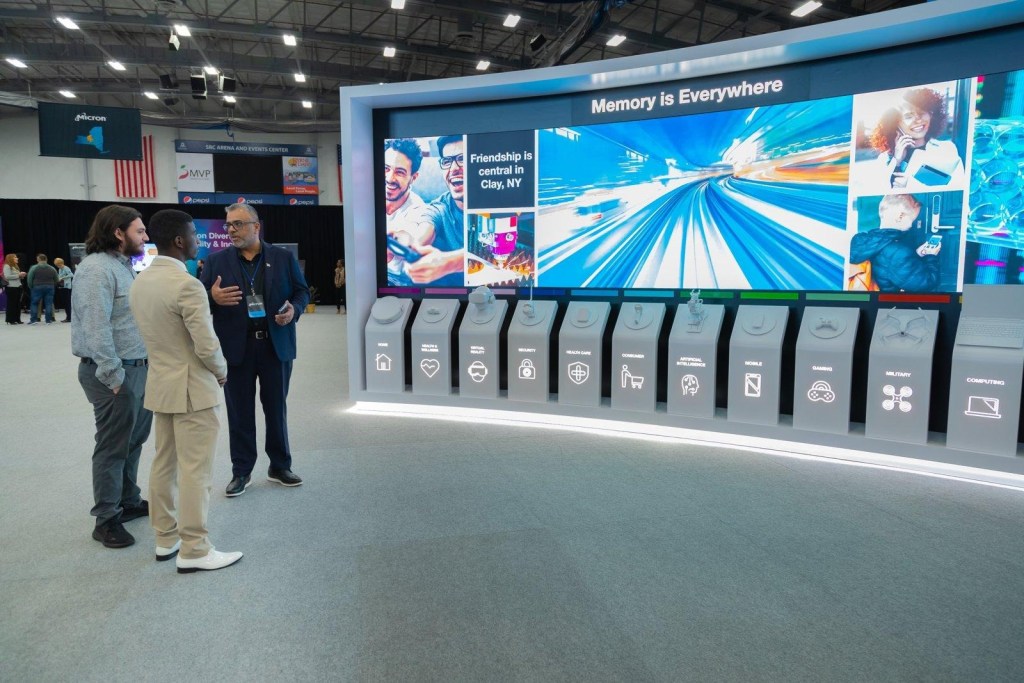 Walking guests through the “Memory is Everywhere” wall in Clay, New York.
Today you’d struggle to find anyone working in AI infrastructure who calls high-bandwidth memory a commodity, because it has become one of the tightest constraints in the whole build-out. I’d love to tell you our wall did that (it didn’t; a few hundred thousand GPUs did most of the work), but when the market finally caught up, the Micron brand was already standing exactly where the evidence said it would be, and getting there early is the part a marketing team actually controls.
Microsoft, 2014-2015: What is a “Hololens”?
Before Micron, I was on the Xbox One launch team at Microsoft, building the community engagement strategy for Project Spark, one of the early free-to-play, games-as-a-service titles. From there I moved to the 3D for Everyone team, which was building the foundational platform that HoloLens would eventually stand on.
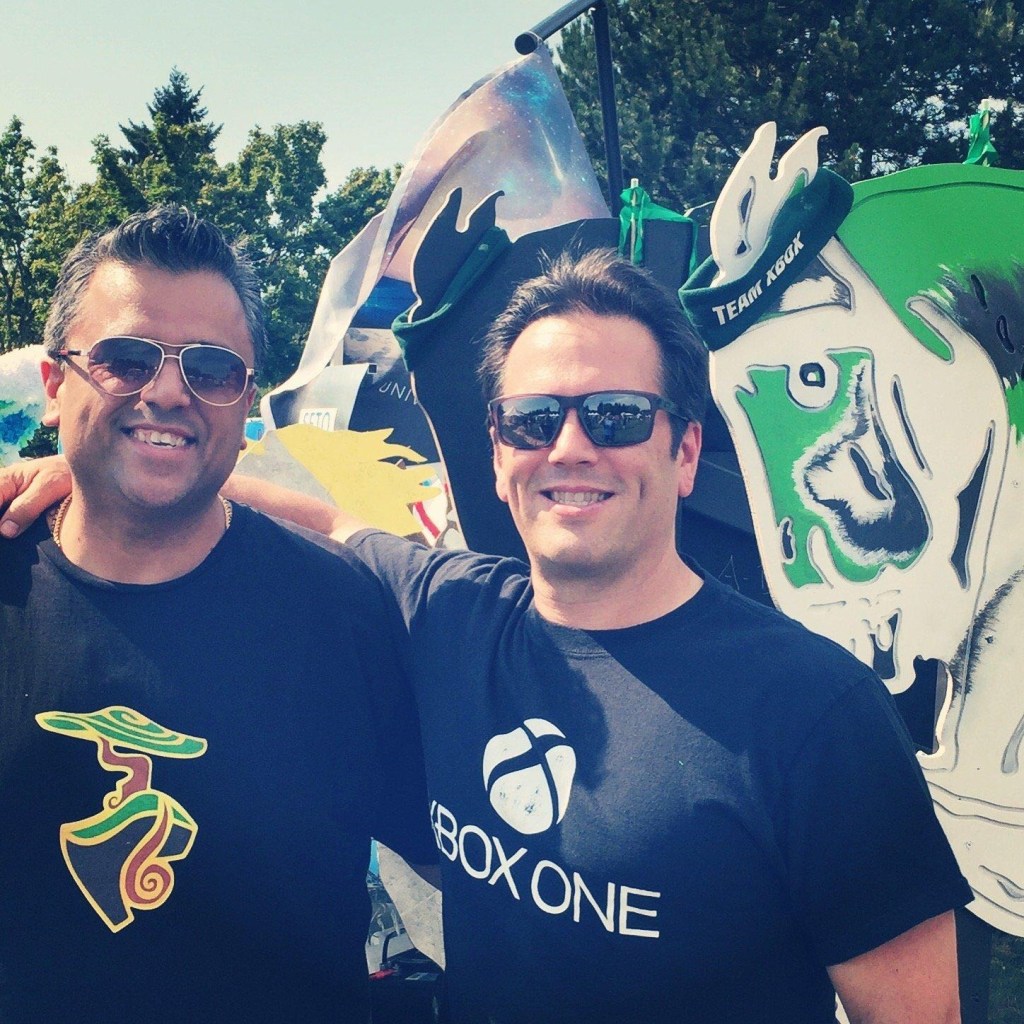 Xbox One days at Microsoft.
That was a much harder perception problem, because it was 2014 and mass adoption of AR, VR and mixed reality was still years away. Everyone knew Microsoft as either the Office or the Xbox brand, so depending on who you asked we were a 2D productivity brand or a flat-screen gaming brand, and boxing HoloLens in as a gaming accessory or a standalone productivity gadget would have badly undersold what it could do. How do you explain an entirely new way of interacting with digital content when your whole brand lives on flat screens?
Looking back, I don’t think any slide could have done that job, and believe me, we made plenty of slides. Describe a hologram in a press release and people picture a science fiction movie, but put one in front of them and they get it in seconds.
My toughest audience turned out to be at home. After we first showed HoloLens to the media, I kept telling my wife and kids about it, and even though every one of them was a gamer (my son Arjun was deep into Minecraft at the time), the enthusiasm in the room was somewhere between polite and missing. Then I managed to get a loaner device to bring home.
Arjun went first. I had set up the Minecraft demo so Steve was running around our house, and I watched a big smile spread across his face as he reached out and controlled the whole thing with his fingers. I’ve rarely seen proof beat messaging as cleanly as it did in my own house that day (and I was the messaging).
Why this matters for MediaTek right now?
For years MediaTek’s brand was known mostly for smartphones, and that reputation had real truth behind it, so I have no interest in running away from it. Mobile is the foundation we’ve built everything else on, and the same engineering muscle that made us the number one smartphone SoC company by unit shipments, a spot we’ve held all through this decade, is what now shows up in PCs, TVs, cars and data centers.
The gap exists because the business moved faster than the brand’s shorthand did. When a friend who carries our silicon in his pocket every day is surprised to find us in flagship PCs, I don’t get to blame him for that; the homework lands squarely on my desk.
That’s why Computex mattered so much, and why what happened in the months after it matters even more. A partner at the top of the AI stack chose to build its PC superchip with us and said so in public, which is third-party proof that no media budget on earth can buy. Then in October the first NVIDIA RTX Spark laptops went on sale from ASUS, Dell, HP, Lenovo, Microsoft and MSI, so the proof is now something you can pick up off a store shelf instead of something you have to take my word for. Evidence like that travels farther than any tagline, all the way to a WhatsApp chat in India at midnight.
What would I tell any CMO facing the same gap?
- Start by finding the last sentence people learned about you. Ask customers, analysts and a few friends outside the industry to describe your company in one line, and write down their exact words rather than your tidied-up version of them, because that is the label you are actually competing with.
- Trade your adjectives for facts people can repeat. Nobody has ever gone home and told their spouse that a chip company was “innovative,” but “number one in smart TV chips” makes it to the dinner table.
- Let your partners carry some of the proof. A partner putting your name inside their product is worth more than a year of ads saying it on yours, and it’s a lot harder for skeptics to argue with.
- Build on your heritage instead of arguing with it. The old label usually has some truth in it, and in my experience, people update much faster when the new story grows out of the one they already believe than when you ask them to throw it away.
- Treat every surprised reaction as data. When someone smart is surprised by what you do, you’ve just been handed a free measurement of how far your brand is running behind your business (it’s an uncomfortable gift, but it’s still a gift).
My friend and I traded a few more messages that night before I finally put the phone down, and I doubt he’ll describe MediaTek as the Android phone chip company again, because what he walked away with was four facts he could go and check for himself the next morning.
Your business can change faster than your brand, and the only fix I’ve found is proof, delivered in public and for long enough that the old label stops fitting. It takes longer than any of us would like, so my advice is to start tonight, preferably before an old friend has to text you about it.
 Your Business Can Change Faster Than Your Brand; Image created using AI
About the author
With over three decades of experience in marketing, communications, and business development, Rahul Sandil is a global marketing leader passionate about building brands, empowering teams, and delivering impactful results across industries. As Vice President and General Manager of Global Marketing and Communications at MediaTek, he serves as the company’s chief marketing and communications executive, overseeing global brand strategy, marketing innovation, strategic partnerships, and corporate communications that connect leading-edge technology with audiences worldwide.
Previously, Rahul held leadership roles at Micron Technology, where he was responsible for corporate marketing, as well as at other global organizations in the technology, digital media, and entertainment sectors, including Microsoft, Amazon, HTC, and others. As a CMO, board advisor, mentor, and consultant, he has leveraged his expertise in AI, emerging technologies, and advanced digital marketing to help brands achieve sustainable growth.
Rahul is passionate about creating customer-centric experiences that connect communities with technology. He believes in the power of storytelling, creativity, and data to drive business outcomes and social impact. He is also an avid geek and usually the first to adopt new consumer tech products. To read more about Rahul’s thoughts on AI, Marketing, and Leadership, check out his blog, connect with him on LinkedIn, subscribe to his Substack newsletter, or follow him on Medium.
Disclosure: The author leverages Generative AI platforms to support content research, copywriting, and editing for his blogs. All ideation, outlines, and strategic insights are the author’s own.
FAQs
Why does brand perception lag behind business change?
Brand perception lags because people keep describing a company with the last sentence they learned about it. Inside the company the change is obvious, because you live it in the products you ship. Outside, most people stopped paying attention a while ago, and they will repeat the old story until someone gives them a new one they can check.
How do you close the gap between brand perception and business reality?
You close the gap between brand perception and business reality with proof, and messaging alone won’t do it. People change their minds when you show them something specific enough to retell at dinner without looking anything up. A fact like “number one in smart TV chips” travels, while an adjective like “innovative” goes nowhere.
Is MediaTek only a smartphone chip company?
No. MediaTek is the number one smartphone SoC company by unit shipments, and it is also the number one chip supplier for smart TVs and for non-x86 Chromebooks. MediaTek is a leader in Wi-Fi and Bluetooth connectivity, builds custom AI ASICs for data centers and collaborated with NVIDIA on the RTX Spark processor for Windows PCs.
How did Micron change the view of memory as a commodity?
Micron changed the view of memory as a commodity by showing where memory already did the heavy lifting, from phones and cars to hospital computers and AI data centers. It backed the story with a $40 billion U.S. manufacturing plan in August 2022 and a commitment of up to $100 billion for a megafab in Clay, New York, where a “Memory is Everywhere” brand wall experience put real devices in front of visitors.
What should a CMO do when the brand is behind the business?
A CMO whose brand is behind the business should start by collecting the exact words customers and analysts use to describe the company today. Then replace adjectives with facts people can repeat, let partners carry some of the proof and build on the company’s heritage. Treat every surprised reaction from a smart person as a measurement of the gap.
Related
